
News
Check out some exciting news below.

New Milestone
PhD Degree Conferral
It was very special to have the chance to return to Penn State for graduation and doctoral hooding. After spending many years in State College and then leaving to begin my postdoctoral research at Princeton, I was grateful to be able to return and celebrate at a place that had become such an important part of my life. It gave me a chance not only to celebrate the completion of my Ph.D. in Bioinformatics and Genomics, but also to reflect on everything that Penn State and the people I met there have meant to me. My years at Penn State shaped me as a scientist, teacher, mentor, and collaborator, while also giving me friendships, experiences, and memories that extend far, far beyond my academic work. I am especially grateful that, even after beginning the next chapter of my career, I was able to return to State College and celebrate this milestone. Penn State will always hold a special place in my life, and I am very glad I had the opportunity to return to campus and celebrate.
15 August 2026
New Position
I am excited to have started my postdoctoral research at Princeton University in the vonHoldt Lab, where I am continuing to study how populations change through time in response to evolutionary and demographic processes. Building on my PhD work at Penn State, I am especially interested in biological systems where genomic data alone cannot fully reveal the processes that shaped populations in the past or determine how they may change in the future. At Princeton, my research is centered on red wolf conservation genomics, with a particular focus on canids along the Gulf Coast that retain red wolf ancestry outside the currently managed red wolf population. This system provides an opportunity to combine genomic data with demographic modeling, simulations, and other computational approaches to better understand how gene flow, population history, and conservation actions have shaped the persistence of red wolf ancestry and genetic variation.
15 July 2026

New Milestone
PhD Dissertation Defense
I am proud to announce I successfully defended my PhD dissertation in Bioinformatics and Genomics at Penn State University. My dissertation used integrative approaches combining simulations, demographic modeling, machine learning, genomic data, and ancient DNA analysis to study how populations change through time. Across case studies spanning coral restoration, the Neolithic expansion, and purifying selection in modern and ancient populations, this work examined how gene flow, selection, and demographic history shape genetic variation in systems where the underlying processes cannot be directly observed. I am grateful to my mentors, committee members, collaborators, labmates, students, friends, and family for their support throughout this process. This milestone reflects the many experiences that shaped me as a scientist, teacher, mentor, and collaborator during my time at Penn State.
14 May 2026
New Position Announcement
I am thrilled to announce that pending the completion of my PhD work at Penn State, I will be joining Princeton University in July as a Postdoctoral Research Associate in the Department of Ecology & Evolutionary Biology with Dr. Bridgett vonHoldt (vonholdt.princeton.edu).
This forthcoming position represents an exciting next step in my research career and an opportunity to continue developing quantitative and computational approaches to important questions in ecology and evolution!
Coming Summer '26

New Penn State News Piece
The 2026 Penn State Nittany AI Challenge recognized MatchMyLab with both a third-place overall finish and second place in the Penn State Office of Physical Plant Special Award, highlighting the project’s impact as an AI solution to teaching assistant scheduling inefficiencies in higher education. After advancing from an initial field of 40 student teams to the 10-team Pitch Phase, MatchMyLab earned an additional $2,500 for placing third overall and $1,500 through the OPP award for its alignment with Penn State’s operational efficiency goals. These honors reinforced our collaborative success with second-year undergraduate students Julien Mutton and Gustavo Rodrigues Foz, creating a practical, scalable platform that addresses a persistent administrative challenge while creating meaningful institutional value.
17 April 2026
New Preprint
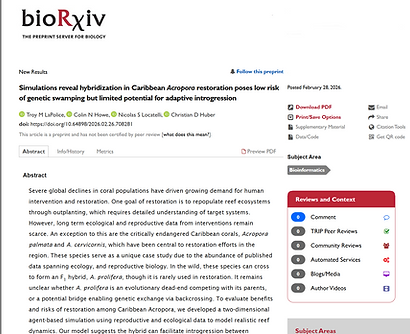
As global coral declines intensify restoration efforts, key questions remain about the evolutionary consequences of hybridization and how they relate to restoration. Focusing on the critically endangered Caribbean corals Acropora palmata and A. cervicornis (which can hybridize to form F1 hybrid A. prolifera), we developed an agent-based simulation to model long-term genetics and ecological dynamics on a digital reef. Our results suggest that while the hybrid can facilitate introgression between parental species without outcompeting them, genetic exchange is too limited to drive adaptive ancestry transfer under unrealistic conditions or management timescales.
28 February 2026

New Penn State News Piece
The Penn State University Nittany AI Challenge recently advanced top student teams to the next phase of funding, recognizing projects that address real institutional challenges through innovative technology. Originally developed from the system I created for BIOL 220, MatchMyLab grew through collaboration with second-year undergraduate students Julien Mutton and Gustavo Rodrigues Foz into a scalable, high-performing platform. Now supporting BIOL 110, 220, 230, and 240 which serve 3,610 students across 155 lab sections, MatchMyLab reduces a weeks-long TA scheduling process to seconds, ensures equitable TA workload distribution, and significantly reduces administrative burden while improving accuracy and flexibility in course coordination.
6 February 2026

New Penn State Research News Piece
This Penn State University research news article highlights our Nature Communications study showing that the spread of farming across Europe was driven primarily by migrating farmers rather than by local hunter-gatherers adopting agriculture. Analyzing ancient DNA from 618 individuals and integrating it with computational simulations, we quantified the relative roles of migration and cultural transmission. Our findings indicate that cultural adoption played only a minimal role, with farmers largely mating within their own groups. The work demonstrates how combining genetics, archaeology, and computational modeling can reveal the demographic forces shaping major transitions in human history.
27 August 2025

New Paper
The Neolithic Revolution marked the transition from foraging to farming, long debated as a product of cultural diffusion versus demic diffusion. Using mathematical models, agent-based simulations, and ancient DNA analysis, we evaluate the relative roles of cultural transmission and between-group mating in farming’s expansion. Our results reveal limited cultural diffusion, predominantly within-group mating, and challenge the assumption that demic expansion necessarily results in ancestry turnover, offering new insights into early agricultural society.
25 August 2025